At home
How to host a whiskey tasting at home
The single best thing you can do with an hour in Edinburgh is learn the method, and the second best is use it when you get back. A tasting at home needs less equipment than people think, costs about the price of two bottles, and follows exactly the running order a professional host uses. Here is the set, the glasses, the order and the timing.
Quick answer
To host a whiskey tasting at home you need one glass per whiskey, four or five whiskeys chosen to contrast, still water and a dropper, something plain to eat, and a printed order of service. Pour 15–25 ml each, go lightest to heaviest with any peated dram last, and allow about ninety minutes for five. A set of six tulip glasses costs roughly what one good bottle does.
What you need
- Glasses
- One per whiskeyfour minimum, six is comfortable
- Glass shape
- Tulip, narrow rimGlencairn, copita or small wine glass
- Pour size
- 15 – 25 mlabout half a US bar measure
- Whiskeys
- 4 or 5chosen to contrast, not to match
- Water
- Still, room temperatureplus a pipette or teaspoon
- Food
- Plainoatcakes, plain crackers, water biscuits
- Not on the table
- Iceit suppresses what you came to notice
- Order
- Lightest firstpeat always last
- Time for five
- ~90 minutesabout fifteen minutes a glass
- Cost of a glass set
- ~$60 for sixroughly one good bottle
- Cheapest way to buy the whiskey
- Miniaturesfive 50 ml bottles beat five full ones
- Where to learn it first
- $32a guided flight in Edinburgh
The running order
How do you run a whiskey tasting at home?
The same shape a professional uses, compressed into something one person can do for six friends.
- 1. Set the table before anybody arrives
Glasses in a row, numbered mat or a folded card under each, water jug, pipette, plain biscuits. Pour nothing yet — whiskey standing open loses its top notes.
- 2. Choose four or five that disagree
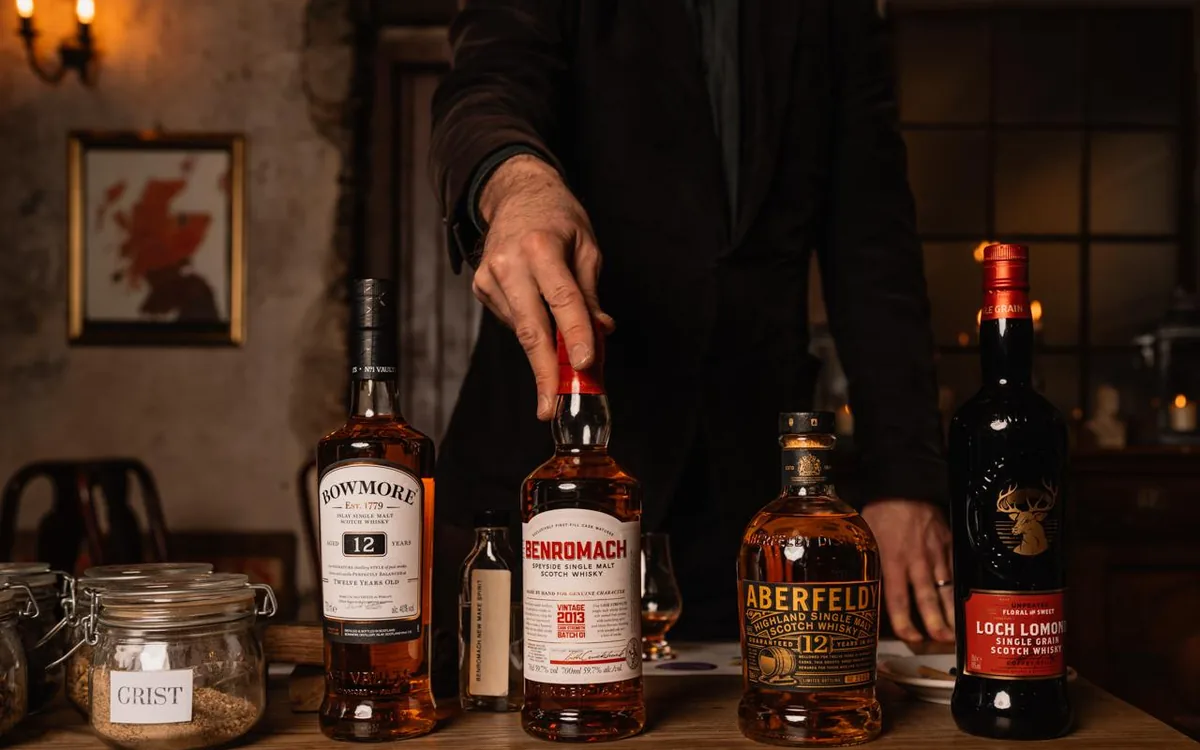
The point is contrast, not a collection of things you like. A light Lowland, a Speyside, a sherried Highland and an Islay is the classic four and covers most of the map.
- 3. Pour small and pour in order
Fifteen to twenty-five millilitres each, lightest first. Peat goes last, always — it flattens the palate for anything gentler after it.
- 4. Nose everything before anybody sips
Go along the row smelling all of them first. The comparison is the lesson, and it disappears once people start drinking.
- 5. Add water to at least one
A few drops, wait thirty seconds, nose again. On a cask-strength dram this is the moment somebody at your table says something out loud.
- 6. Finish with a vote
Ask everybody for a favourite and a least favourite. It takes two minutes, it is the part people remember, and it teaches more than any tasting note.
The set
What should be in a whiskey tasting set?
Glasses first, whiskey second. A set of six tulip glasses costs about what one good bottle does and improves every whiskey you will ever drink at home. If you are buying one thing, buy those.
Miniatures beat full bottles. Five 50 ml miniatures give you five distinct whiskeys for a fraction of the price of five bottles, and 50 ml is two tasting pours. Many pre-assembled tasting sets are exactly this, and they are usually good value even allowing for the packaging.
A dropper matters more than it should. A pipette, a small syringe or even a straw with your finger over the end. Adding water from a jug means adding too much, and too much is irreversible.
Something plain to eat. Oatcakes or water biscuits, not cheese and not chocolate unless you are deliberately pairing. The job is resetting the palate, not adding to it.
What you do not need: a tasting wheel poster, a decanter, a stone chilling cube, or anything described as a whiskey-tasting accessory. The list above is the whole list.
The method is the part worth learning properly, and ninety minutes with a professional host in Edinburgh does it faster than a year of reading.
The five-step method→Variations
Four other ways to run it
Once the basic format works, these are the versions people ask about.
- A blind tasting
Wrap the bottles or have somebody else pour. It removes the label effect entirely, which is larger than anybody wants to admit, and it makes the vote at the end genuinely interesting.
- A vertical
Several ages of the same distillery side by side. It is the clearest possible demonstration of what time in a cask does, and it is expensive.
- A pairing
Dark chocolate against a peated Islay is the classic and it works. Add one pairing to a normal flight rather than building the whole evening on it.
- A virtual tasting
Everybody buys the same miniatures, one person hosts over video and walks the group through the order. It works better than it sounds, and the only hard part is agreeing the set in advance.
Every trip, current fare
Learn it properly first, in Edinburgh
The four tastings that spend the most time on method rather than on stories, cheapest first.
| Tasting | Length | Price | Drams poured | Cost per hour | Rating |
|---|---|---|---|---|---|
| The Scotch Whisky ExperienceAll five regions, on Castlehill | 75 min | $32 | Four or five | $25.60 | 4.7 · 6,656 |
| Scotland's True Spirit TastingMethodical, region by region | 1.5 h | $45 | Four or five | $30.00 | 4.8 · 32 |
| History of Whiskey Tour and TastingThe history and the tasting together | 2 h | $51 | Four or five | $25.50 | 4.9 · 156 |
| Tasting with a Local ExpertThree hours with one local expert | 3 h | $143 | Five or more | $47.67 | 4.7 · 17 |
Common questions
Hosting at home, answered
How do you host a whiskey tasting at home?
Set out one glass per whiskey with still water and a dropper, choose four or five whiskeys that contrast rather than match, pour 15 to 25 ml each in order from lightest to heaviest with any peated dram last, nose everything before anybody sips, and finish with a vote. Allow about ninety minutes for five.
What should be in a whiskey tasting set?
One tulip glass per whiskey, four or five contrasting whiskeys, still water and a pipette, and something plain to eat such as oatcakes. Miniatures are usually better value than full bottles for this.
How many whiskeys for a tasting at home?
Four or five. Fewer than four gives you nothing to compare; more than five and the last ones do not register.
What order should you pour them in?
Lightest to heaviest, with any peated whiskey last. Peat flattens the palate for anything gentler after it, so pouring Islay early ruins the rest of the flight.
How much whiskey do you pour per person?
Fifteen to twenty-five millilitres per glass. Five of those comes to about two standard drinks, which is why a tasting is a manageable evening rather than a heavy one.
Can you host a virtual whiskey tasting?
Yes, and it works well. Everybody buys the same set of miniatures in advance, one person hosts over video and walks the group through the order. Agreeing the set beforehand is the only difficult part.
What food goes with a whiskey tasting?
Something plain that resets the palate — oatcakes, water biscuits, plain crackers. Save cheese and chocolate for a deliberate pairing rather than putting them on the table by default.
Do you need special glasses?
You need a tulip shape that narrows at the rim, and a small white wine glass will do. A set of six proper tasting glasses costs about what one good bottle does and is the better purchase.
Choosing the whiskeys
Which five whiskeys should you buy for a tasting at home?
Five that disagree, in the order that makes each explain the next.
Not five you already like. Five that disagree with each other, which is a different and much more useful list.
The classic set follows the flight you would be poured in Edinburgh, and it works because each one makes the next one legible:
One Lowland — light, grassy, clean. This is the baseline, and without it the rest have nothing to be bigger than.
One Speyside, ex-bourbon cask — honey, orchard fruit, vanilla. The style most people already have in mind when they say Scotch.
One Highland or Speyside, sherry cask — dried fruit, raisin, Christmas cake. Beside the previous glass this is the clearest demonstration of what a cask does that you will ever get.
One peated Islay — smoke, iodine, sea air. Last, always. It is the glass the evening will be remembered for whichever way people react.
Optionally one Campbeltown, if you can find it, purely because almost nobody at your table will have had one.
Buy them as miniatures if you can. Five 50 ml bottles cost a fraction of five full ones and 50 ml is two tasting pours, so a set covers a second evening.
Running it well
Six things that make a home tasting better
Small, and they are the difference between an evening people talk about and one they forget.
- Number the glasses
A folded card under each. It sounds fussy until three people have moved a glass and nobody knows which was which.
- Pour everything before you start
Not one at a time. Whiskey standing for ten minutes opens up, and the comparison across all five is the entire lesson.
- Do the noses as a round
All five, everybody, before anybody drinks. This is the part people skip and the part that teaches most.
- Keep the bottles out of sight
Even semi-blind changes the evening. Label recognition is a stronger effect than anyone wants to admit.
- Put water on the table from the start
Both for drinking and for the drops. If it appears halfway through, half the room will already have finished glass three.
- End with a vote and write it down
Favourite and least favourite from everybody. Two minutes, and it is the only record anybody will actually reread.
Go deeper
More on tasting whiskey
What is a whiskey tasting?
What actually happens, how long it takes, and what is in the price.
TechniqueHow to taste whiskey
Nose, sip, add water. Five steps that change what you can taste.
The glassWhiskey tasting glasses
Why the Glencairn exists, and what a rocks glass throws away.
NotesWhiskey tasting notes
What the flavour wheel is for, and how to write notes you can reuse.
ComparedScotch vs bourbon
Two legal definitions, one new-oak rule, and most of the taste difference.
ComparedIrish whiskey vs Scotch
Triple distillation, peat, and whether Dublin or Edinburgh is the better stop.