Best
What is the best-tasting whiskey? An honest answer
Nine hundred people a month ask a search engine this, and every article that answers it with a single bottle is selling something. There is no best-tasting whiskey, and that is not a dodge — it is a fact about how taste works, and once you accept it the question becomes answerable. What you want is the best-tasting whiskey for you, and there is a reliable ninety-minute method for finding it.
Quick answer
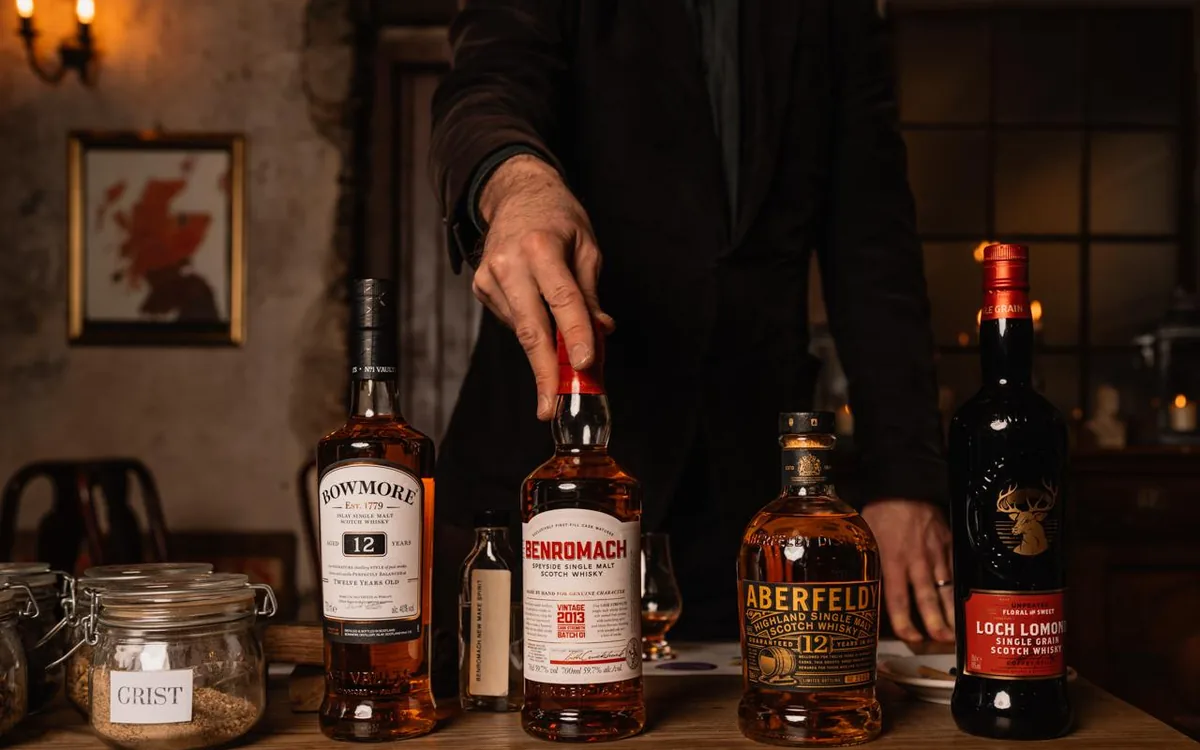
There is no single best-tasting whiskey, because preference splits along axes that genuinely divide people — sweet against dry, smoky against clean, light against heavy. The reliable way to find yours is a guided flight of four or five regional styles poured in order, which is exactly what an Edinburgh tasting is and costs from $32. Most people find the answer at glass three, and it is usually not the one they expected.
Finding your whiskey, at a glance
- Best-tasting whiskey
- No such thingand anyone naming one is guessing
- What varies
- Four axessweet, smoke, weight, finish
- Fastest way to find yours
- A guided flightfour or five styles side by side
- Time it takes
- 90 minutesusually settled by glass three
- Cheapest in Edinburgh
- $32and it covers all five regions
- If you like bourbon
- Start Speysidesherry-cask sweetness is the closest thing
- If you like gin
- Start Lowlandlight, grassy, clean
- If you like mezcal
- Start Islaysmoke is the shared language
- If you like rum
- Sherry-cask Highlanddried fruit and depth
- Best for drinking straight
- Anything at 46%+more texture, less need for water
- Most divisive style
- Peated Islayand that is the point of trying it
- Age
- Not the same as qualityand never was
Why there is no answer
Why can nobody tell you the best-tasting whiskey?
Three preference axes and one quality axis. Only the fourth has a right answer.
Because the differences that matter are not on a quality scale. They are on preference axes, and people sit at genuinely different points on them.
Sweet against dry. A sherry-cask Speyside and a bone-dry Lowland are both excellent and they are not competing. Somebody who wants one usually does not want the other.
Smoke against no smoke. This is the sharpest divide in whiskey. Peated Islay malt is medicinal, maritime and unmistakable, and the room splits down the middle every single time. No amount of expertise resolves it, because it is not a question with a correct answer.
Light against heavy. Triple-distilled and delicate, or oily and thick. Again, a preference.
Short against long. The one axis where more is usually better: a long finish generally does mark a better-made whiskey. It is also the easiest thing for a beginner to measure — swallow and count.
So the useful question is not which whiskey is best. It is where you sit on those four axes, and the only way to find out is to taste across them.
The shortcut
What should you try first, based on what you already drink?
Not a rule, but a reliable starting point — and telling your host this at the start is the single most useful thing you can do.
- If you drink bourbon
Ask for a sherry-cask Speyside first. Dried fruit and sweetness are the nearest thing to what new charred oak gives you, so the leap is short and you arrive with your bearings.
- If you drink gin
Start Lowland. Light, grassy, floral and clean — it shares more with a good London dry than most people expect, and it is the gentlest possible entry.
- If you drink mezcal or smoky cocktails
Go straight to Islay. You already speak the language, and the medicinal, maritime version of smoke will delight rather than alarm you.
- If you drink aged rum
A sherry-cask Highland. Dried fruit, depth and a long sweet finish. This is the closest Scotch comes to what you already like.
- If you drink almost nothing
Take the standard five-region flight and say so at the start. It is designed for exactly this, and the host will slow down.
- If you already know Scotch
Ask for something outside your region. The point of an hour with an expert is to be taken somewhere you would not have gone alone.
The method matters as much as the whiskey. Five minutes of technique changes what you can taste more than fifty dollars of bottle does.
The five-step method→Age and price
Does older or more expensive whiskey taste better?
Not reliably, and the belief that it does costs people a lot of money.
Age is a measurement, not a grade. An age statement tells you the youngest drop in the bottle. More time in cask means more wood influence, which is good up to a point and past that point is just wood. Plenty of twelve-year-olds beat plenty of eighteen-year-olds, and the price gap between them is far larger than the quality gap.
Colour tells you almost nothing. Caramel colouring is legal in Scotch and widely used for consistency. A darker whiskey is not an older one.
Strength does matter, but not as quality. Anything bottled at forty-six per cent or above generally carries more texture and aroma, which is why enthusiasts favour it. It also gives you something to add water to.
The one thing that does track with quality is the finish. Count it. A whiskey that is still developing in your mouth a minute after you swallowed is a well-made whiskey, and that is true at any price.
Every trip, current fare
Where to find yours, in Edinburgh
A flight is the fastest way to answer this question, and the cheapest one covers every regional style there is.
| Tasting | Length | Price | Drams poured | Cost per hour | Rating |
|---|---|---|---|---|---|
| The Scotch Whisky ExperienceAll five regions, on Castlehill | 75 min | $32 | Four or five | $25.60 | 4.7 · 6,656 |
| Royal Mile Whiskey TastingA straight guided flight on the Royal Mile | 1.5 h | $38 | Four or five | $25.33 | 5.0 · 15 |
| Tasting and Storytelling in a PubTwo hours at a table in a working pub | 2 h | $42 | Four or five | $21.00 | 4.9 · 32 |
| Royal Mile Tasting MasterclassThe shortest serious tasting here | 1 h | $43 | Four | $43.00 | 5.0 · 2 |
| Scotland's True Spirit TastingMethodical, region by region | 1.5 h | $45 | Four or five | $30.00 | 4.8 · 32 |
| History of Whiskey Tour and TastingThe history and the tasting together | 2 h | $51 | Four or five | $25.50 | 4.9 · 156 |
| Mountebank Comedy Whiskey TastingA tasting played for laughs | 1.5 h | $51 | Four | $34.00 | 4.8 · 9 |
| Luxury Whiskey and Chocolate TastingWhiskey against Scottish chocolate | 1 h | $96 | Four, with chocolate | $96.00 | 4.6 · 11 |
| Tasting with a Three-Course DinnerThree courses with the tasting through them | 3 h 20 | $121 | Four, through dinner | $36.67 | 4.8 · 45 |
| Tasting with a Local ExpertThree hours with one local expert | 3 h | $143 | Five or more | $47.67 | 4.7 · 17 |
| Tastings and Distilleries DayA full day of tastings and distilleries | 9 h 45 | $152 | Several, all day | $15.59 | New |
| Johnnie Walker Cask Draw TastingDrawn straight from the cask | 1.5 h | $191 | From the cask | $127.33 | 5.0 · 1 |
Common questions
The best-tasting whiskey, answered
What is the best-tasting whiskey?
There is no single answer, because the main differences are preference axes rather than quality ones: sweet against dry, smoky against clean, light against heavy. The reliable way to find yours is a guided flight of four or five regional styles, which settles it for most people in about ninety minutes.
What is the best-tasting whiskey to drink straight?
Generally something bottled at 46 per cent or above, because higher strength carries more texture and aroma. Beyond that it depends where you sit on the sweet-dry and smoky-clean axes, which a flight will tell you.
Does more expensive whiskey taste better?
Not reliably. Price tracks scarcity, age and marketing at least as much as quality. The one thing that does track with quality is length of finish, and you can measure that yourself by counting the seconds after you swallow.
Is older whiskey better?
Not automatically. An age statement records the youngest whiskey in the bottle, and more time in cask means more wood influence, which is good up to a point and past it is simply woody. Many twelve-year-olds beat many eighteen-year-olds.
Does darker whiskey taste better?
No, and colour is the least reliable signal on the table. Caramel colouring is legal in Scotch and widely used for batch consistency, so a darker whiskey is not an older or better one.
I like bourbon — which Scotch should I try?
A sherry-cask Speyside first. Its dried fruit and sweetness are the nearest thing to what new charred oak gives bourbon, so the step across is short. Tell the host you drink bourbon and the flight will be built around it.
What is the most divisive whiskey style?
Peated Islay. The malt is dried over peat smoke and arrives as smoke, iodine and sea air, and it splits every tasting room in half. Trying it is the point rather than the risk.
How do I judge a whiskey without knowing anything?
Count the finish. Swallow, then count the seconds until the flavour fades. Five, twenty, sixty. It is the one measure a beginner can take that genuinely correlates with how well the whiskey was made.
Awards
Do whiskey awards mean anything?
A medal says competently made. It cannot say you will like it.
A little, and much less than the gold stickers suggest.
Most competitions judge blind, in flights, by category, which is a sound method. The difficulty is what happens afterwards: the number of medals awarded is large, the categories are narrow, and a bottle can truthfully claim gold in a class of eleven entrants.
A medal is therefore weak evidence that a whiskey is competently made and almost no evidence that you will like it — because the thing that decides whether you like it is where you sit on the sweet-dry and smoky-clean axes, and no panel can know that.
The exception worth respecting is a specific, named award in a specific year from a competition you can look up. “Award-winning” with nothing after it is packaging.
Your own note from a tasting is better evidence than any of it. You were there, you were comparing five things side by side, and you know what you liked.
Cost
Six ways to drink better without spending more
None of these involves buying a more expensive bottle.
- Fix the glass first
A twelve-dollar tulip improves every bottle you already own, permanently. Nothing else on this list has that return.
- Add water and actually wait
Thirty seconds, not three. Most people add the water and taste immediately, which is the one way to make the step do nothing.
- Drink it at room temperature
Not chilled, not warmed in your hands. Both suppress what you paid for.
- Buy at 46 per cent or above
More texture and aroma per dollar than an extra six years of age, and it gives you something to dilute.
- Try the region you think you dislike
The most common upgrade in anybody’s drinking is discovering they were wrong about peat, or about sherry casks.
- Taste two at a time
Comparison is free and it is where all the information is.
Go deeper
More on tasting whiskey
What is a whiskey tasting?
What actually happens, how long it takes, and what is in the price.
TechniqueHow to taste whiskey
Nose, sip, add water. Five steps that change what you can taste.
The glassWhiskey tasting glasses
Why the Glencairn exists, and what a rocks glass throws away.
NotesWhiskey tasting notes
What the flavour wheel is for, and how to write notes you can reuse.
ComparedScotch vs bourbon
Two legal definitions, one new-oak rule, and most of the taste difference.
ComparedIrish whiskey vs Scotch
Triple distillation, peat, and whether Dublin or Edinburgh is the better stop.