The basics
What is a whiskey tasting?
It is the question more Americans type into Google than any other on this subject, and the honest answer is shorter than the mystique suggests. A whiskey tasting is a guided hour with four or five small measures, poured in an order chosen on purpose, and somebody whose job is to tell you what changed between them. Nothing about it requires you to know anything in advance.
Quick answer
A whiskey tasting is a guided session, usually 60 to 90 minutes, in which a host pours four or five small measures in a deliberate order and explains what changes between them. In Edinburgh the order is almost always by Scotch region — Lowland, Highland, Speyside, Islay and sometimes Campbeltown. The whiskey is included in the ticket price, which runs from $32 to $191. No experience is assumed and nothing is a test.
A whiskey tasting, at a glance
- What it is
- A guided flightfour or five measures, in order
- How long
- 60 – 90 mintwo hours for the small-group ones
- Measures poured
- 4 – 5included in the ticket price
- Pour size
- 15 – 25 mlabout half a US bar pour, each
- The order
- By regionlightest first, peat last
- The glass
- A Glencairna tulip, not a rocks glass
- Water
- Offered, and usefula few drops, not a splash
- Knowledge needed
- Nonethe good hosts prefer beginners
- Cheapest in Edinburgh
- $32and it covers all five regions
- Highest price
- $191drawn straight from a cask
- Legal age in Scotland
- 18not 21
- Cancellation
- Free to 24 hon every tasting on this site
What happens
What actually happens at a whiskey tasting?
A mat, five glasses, and somebody explaining what changed between them.
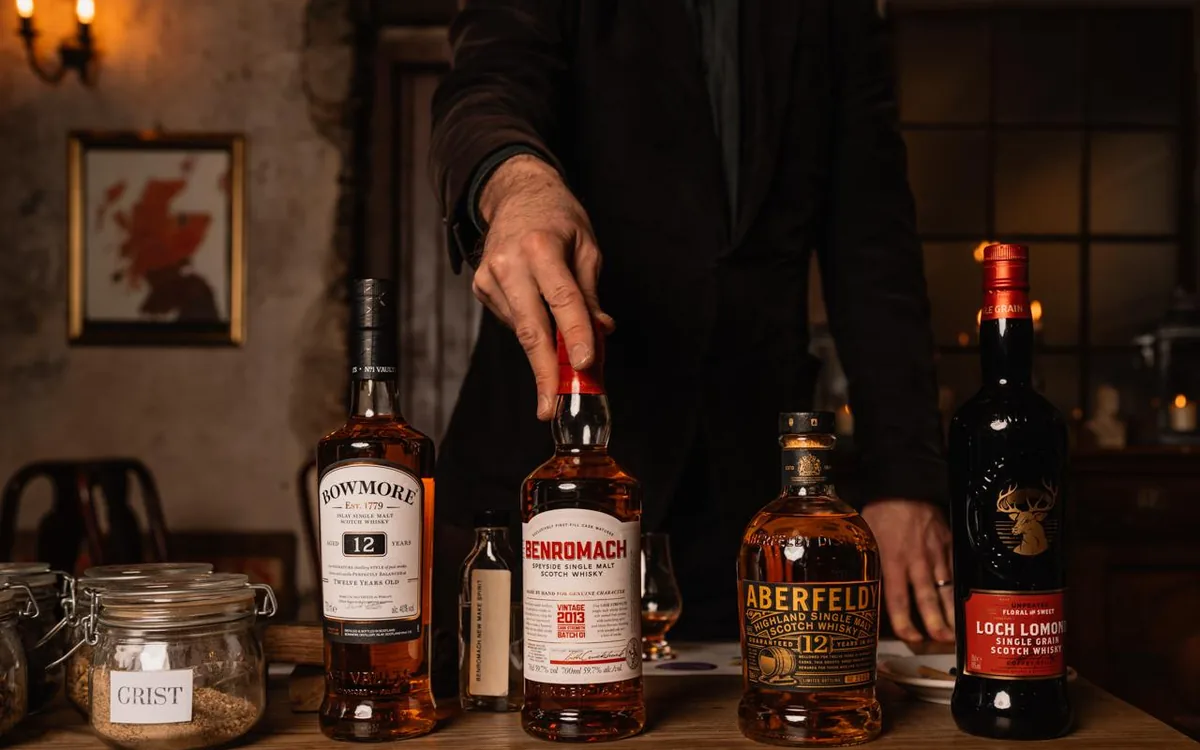
You sit down at a table. In front of you is a paper mat with four or five circles printed on it and a glass standing on each circle. The glass is a tulip that narrows at the rim — almost always a Glencairn, which has been made in Scotland since 2001 — and the shape is doing real work, because it gathers the aromatics and points them at your nose.
The host pours the first measure and asks you to smell it before you taste it. That is not ceremony. Most of what you experience as flavour is smell, and a tasting is largely a lesson in noticing that.
Then you work along the row. Each pour is fifteen to twenty-five millilitres — call it half a normal US bar measure — and between them the host explains what changed and why. Somewhere in the middle you are told to add a drop of water, which sounds like vandalism and is the most useful thing anyone will teach you all week.
At the end you will have an opinion. Almost everybody finds one they did not expect to like, and almost never in the region they walked in loyal to. That is the product.
The order
Why are the whiskeys poured in that particular order?
The sequence is the single most deliberate thing about the hour, and it is the reason a tasting teaches you more than five separate drinks would.
- Lowland opens the flight
Light, grassy, gentle. You need a baseline before anything else can taste big, and a Lowland is the softest possible place to start.
- Then Highland, the wide one
The largest region and the least consistent, which is a feature rather than a flaw. It shows you how much range the word Scotch actually covers.
- Then Speyside, the one you already know
Around fifty distilleries in a small area, making the honey-and-orchard-fruit style most people picture when they hear the word. Formally recognised as its own region only in 2014.
- Then Islay, and the room splits
Nine distilleries on one island, malt dried over peat smoke, and it arrives as smoke, iodine and sea air. Half the table falls in love and half never will.
- Campbeltown last, if it appears
Three working distilleries left on a peninsula that once had more than thirty. If it is on your mat, it is the rarest thing there.
- Never peat third
A peated dram flattens your palate for anything gentler afterwards. Any host who pours Islay early is not thinking about you.
Every trip, current fare
Every Edinburgh whiskey tasting, priced
Twelve tastings, cheapest first, with the number of measures each one pours. That column is the one no listing gives you and the one that actually decides value.
| Tasting | Length | Price | Drams poured | Cost per hour | Rating |
|---|---|---|---|---|---|
| The Scotch Whisky ExperienceAll five regions, on Castlehill | 75 min | $32 | Four or five | $25.60 | 4.7 · 6,656 |
| Royal Mile Whiskey TastingA straight guided flight on the Royal Mile | 1.5 h | $38 | Four or five | $25.33 | 5.0 · 15 |
| Tasting and Storytelling in a PubTwo hours at a table in a working pub | 2 h | $42 | Four or five | $21.00 | 4.9 · 32 |
| Royal Mile Tasting MasterclassThe shortest serious tasting here | 1 h | $43 | Four | $43.00 | 5.0 · 2 |
| Scotland's True Spirit TastingMethodical, region by region | 1.5 h | $45 | Four or five | $30.00 | 4.8 · 32 |
| History of Whiskey Tour and TastingThe history and the tasting together | 2 h | $51 | Four or five | $25.50 | 4.9 · 156 |
| Mountebank Comedy Whiskey TastingA tasting played for laughs | 1.5 h | $51 | Four | $34.00 | 4.8 · 9 |
| Luxury Whiskey and Chocolate TastingWhiskey against Scottish chocolate | 1 h | $96 | Four, with chocolate | $96.00 | 4.6 · 11 |
| Tasting with a Three-Course DinnerThree courses with the tasting through them | 3 h 20 | $121 | Four, through dinner | $36.67 | 4.8 · 45 |
| Tasting with a Local ExpertThree hours with one local expert | 3 h | $143 | Five or more | $47.67 | 4.7 · 17 |
| Tastings and Distilleries DayA full day of tastings and distilleries | 9 h 45 | $152 | Several, all day | $15.59 | New |
| Johnnie Walker Cask Draw TastingDrawn straight from the cask | 1.5 h | $191 | From the cask | $127.33 | 5.0 · 1 |
The whiskey itself
What makes something Scotch whisky in the first place?
Worth knowing before you sit down, because it explains what you are about to taste.
Under the Scotch Whisky Regulations 2009 a whisky may be called Scotch only if it is distilled and matured in Scotland, spends at least three years in oak casks of no more than seven hundred litres, is distilled below 94.8 per cent alcohol, is bottled at no less than forty per cent, and has nothing added to it but water and plain caramel colouring.
Every one of those is law rather than tradition, and together they are why a tasting works at all: you are comparing five things made under identical constraints. Every difference you can taste came from the barley, the still, the cask or the place — not from anything anyone added afterwards.
That is also the sharpest difference from bourbon, which must use new charred oak and has no minimum age at all unless the label says straight. New oak gives flavour fast and loudly. Used oak gives it slowly, which is why three years is a floor almost nobody stops at.
If you already drink bourbon, that one paragraph about new oak explains most of what you are about to notice.
Scotch against bourbon, in full→Before you go
Six things worth knowing beforehand
None of this is in the listing, and all six change how the hour goes.
- Eat something first
Four or five measures in ninety minutes on an empty stomach is the commonest way to waste the ticket. Every host in Edinburgh says this unprompted.
- Not on your first afternoon in Scotland
Edinburgh is five hours ahead of New York and eight ahead of Los Angeles. Jet lag plus Scotch is a nap, not a memory. Book it for day two.
- Say what you already drink
Bourbon, rye, nothing at all — tell the host at the start. The flight gets pitched at you rather than over you, and they would rather know.
- You do not have to finish anything
Nobody is counting. Leaving half a dram you dislike is completely normal and the good hosts say so before they start.
- Nobody is driving
Every tasting on this site is walkable from the Royal Mile. That is the whole reason to do this in a city rather than in whisky country.
- The legal age here is 18
Not 21. Relevant if you are travelling with somebody in between, though each operator sets its own minimum and publishes it.
Common questions
Whiskey tastings, answered
What is a whiskey tasting?
A guided session of roughly sixty to ninety minutes in which a host pours four or five small measures of whiskey in a deliberate order and explains what changes between them. In Edinburgh the order is by Scotch region. The whiskey is included in the price.
How many whiskeys do you get at a tasting?
Four or five at a standard Edinburgh tasting, one from each Scotch region. Each pour is fifteen to twenty-five millilitres — roughly half a US bar measure — so the total is about two standard drinks over an hour and a half.
How long does a whiskey tasting take?
Sixty to ninety minutes for most, two hours for the small-group sessions that braid in the history, and about three and a half hours if the tasting runs through a dinner.
Do you need to know anything about whiskey first?
No. The best-reviewed tastings here are explicitly built for people who do not, and hosts in Edinburgh would generally rather teach a beginner than perform for an expert. Say at the start that Scotch is new to you.
How much does a whiskey tasting cost?
In Edinburgh, from $32 for a guided flight covering all five regions to $191 for whiskey drawn straight from a cask. The measures are always included in the ticket price.
Should you add water to whiskey at a tasting?
Yes, to at least one. Water breaks the surface tension and releases aromatic compounds the alcohol was holding down, and on a cask-strength whiskey the change is dramatic rather than subtle. A few drops, not a splash.
Do you eat at a whiskey tasting?
Usually not, beyond water and sometimes a little chocolate or shortbread. Eat a proper meal beforehand. Two of the tastings on this site are built around food deliberately — a chocolate pairing and a three-course dinner.
Is a whiskey tasting worth it if I only drink bourbon?
Especially then. The entire point of a regional flight is comparison, and arriving with a clear preference makes the differences land harder. Tell the host you are a bourbon drinker and the hour will be built around that.
Alcohol
How much alcohol is in a whiskey tasting?
Four or five pours is about two standard drinks across an hour and a half.
Less than people expect, and this is worth saying plainly because it stops a lot of sensible people booking.
A tasting pour is fifteen to twenty-five millilitres. Five of them is somewhere between seventy-five and a hundred and twenty-five millilitres of spirit at roughly forty to forty-six per cent — which comes to about two US standard drinks, spread across ninety minutes, with water on the table throughout.
That is less than two pints of beer, and it is why people walk out of a tasting perfectly clear-headed and slightly surprised. Nobody is trying to get you drunk; a host whose guests stop noticing things has failed at their job.
You are also under no obligation to finish anything. Leaving half a dram you dislike is completely normal, spittoons exist at the more serious sessions, and asking for water rather than the next pour is met with nothing but approval.
Go deeper
More on tasting whiskey
How to taste whiskey
Nose, sip, add water. Five steps that change what you can taste.
The glassWhiskey tasting glasses
Why the Glencairn exists, and what a rocks glass throws away.
NotesWhiskey tasting notes
What the flavour wheel is for, and how to write notes you can reuse.
ComparedScotch vs bourbon
Two legal definitions, one new-oak rule, and most of the taste difference.
ComparedIrish whiskey vs Scotch
Triple distillation, peat, and whether Dublin or Edinburgh is the better stop.
BestThe best-tasting whiskey
Why the question has no single answer, and how to find yours in an hour.